

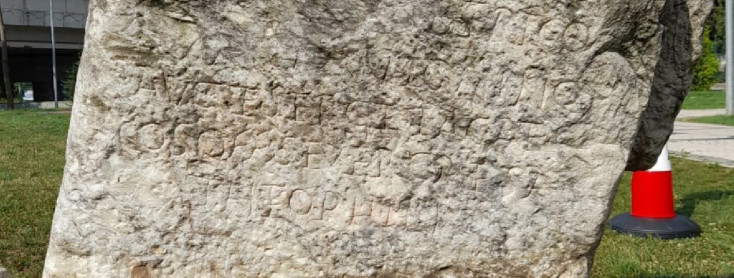
Pierres Errantes: Two Latin Inscriptions transported from the Docimium Quarries to Istanbul

LIBRI XI (2025) 279-293
Geliş Tarihi: 10.11.2025 | Kabul Tarihi: 16.12.2025
DOI: 10.5281/zenodo.18039501
Elektronik Yayın Tarihi: 24.12.2025


Abstract: This study presents two Latin inscriptions currently exhibited in Sanatçılar Parkı in Ataköy, Istanbul, which originally belonged to the Roman Imperial marble quarries of Docimium (modern Iscehisar, Afyon). One of the inscriptions was previously discovered in the Bacakale sector of the Docimium quarries and was published in 1991. Although the other inscription remains unpublished, it was most likely brought to Istanbul together with the former piece. After situating these fragments within the broader corpus of quarry inscriptions, they are re-examined here in light of the earlier studies by J. C. Fant, M. Christol, and Th. Drew-Bear, with particular attention to their epigraphic and historical contexts. The inscriptions illustrate the use of standard abbreviations designating quarry sections (bracchium, locus), the workshop engineer (officina), and the quarry engineer (caesura), thereby providing evidence for the complex bureaucratic system that regulated production and transport. The paper also addresses the transfer of these inscriptions to Istanbul, while expressing concerns about the ongoing threats that modern quarrying activities pose to archaeological evidence.
Keywords: Docimium, Marble Quarries, Bracchium, Officina, Caesura, Marble Trade
Öz: Bu çalışmada, günümüzde İstanbul Ataköy Sanatçılar Parkı’nda sergilenen ve kökeni Roma İmparatorluk Dönemi Dokimeion (İscehisar/Afyon) mermer ocaklarına uzanan iki Latince yazıt ele alınmaktadır. Yazıtlardan biri daha önce Dokimeion taş ocaklarının Bacakale sektöründe tespit edilmiştir ve 1991 yılında yayımlanmıştır. Diğeri ise yayımlanmamış olup muhtemelen onunla birlikte İstanbul’a getirilmiştir. Bu fragmanlar, taş ocağı yazıtlarının daha geniş bir külliyatı içinde konumlandırıldıktan sonra, J. C. Fant, M. Christol ve Th. Drew-Bear’ın önceki çalışmaları ışığında epigrafik ve tarihsel bağlamları açısından yeniden incelenmektedir. Yazıtlar, taş ocağı bölümlerini (bracchium, locus), atölye mühendisini (officina) ve taş ocağı mühendisini (caesura) belirten standart kısaltmaların kullanımını göstermekte ve üretim ve nakliyeyi düzenleyen karmaşık bürokratik sistemin kanıtını sunmaktadır. Makalede ayrıca, söz konusu yazıtların İstanbul’a taşınması ele alınmakta olup modern taş ocağı faaliyetlerinin arkeolojik kanıtlar üzerinde oluşturduğu süreğen tehditlere ilişkin endişeleri de dile getirilmektedir.
Anahtar sözcükler: Dokimeion, Mermer Ocakları, Bracchium, Officina, Caesura, Mermer Ticareti
Albustanlıoğlu T. 2006, Dokimeion Işığı Altında Roma İmparatorluk Döneminde Mermer Kullanımı; İmparatorluk Yöntemindeki Anadolu Mermer Ocaklarının İşletme Stratejisi ve Organizayonu. Yayımlanmamış Doktora Tezi, Ankara University. Ankara.
Albustanlıoğlu T. 2007, “Roma İmparatorluk Mermer Ocağında Locus’un İşlevi”. Eds. E. Öztepe & M. Kadıoğlu, Patronus: Coşkun Özgünel’e 65. Yaş Armağanı / Festschrift für Coşkun Özgünel zum 65. Geburtstag. İstanbul, 29-33.
Alföldy G. 1976, “Consuls and Consulars under the Antonines: Prosopography and History”. AncSoc 7, 263-299.
Alföldy G. 1977, Konsulat und Senatorenstand unter den Antoninen. Bonn.
Baccini Leotardi P. 1979, Marmi di cava rinvenuti ad Ostia e considerazioni sul commercio dei Marmi in età romana (Scavi di Ostia X). Rome.
Baccini Leotardi P. 1989, Nuove testimonianze sul commercio dei marmi in età imperiale (Studi pubblicati dall’Istituo italiano per la storia antica 44). Rome.
Bruzza L. 1870, “Iscrizioni dei marmi grezzi”. Annali dell’Instituto di Corrispondenza Archaeologica 42, 106–204.
Christol M. & Drew-Bear Th. 1986, “Documents latins de Phrygie”. Tyche 1, 41-96.
Christol M. & Drew-Bear Th. 1987, “Inscriptions de Dokimeion”. Anatolia Antiqua – Eski Anadolu I, 83-137.
Christol M. & Drew-Bear Th. 1991, “Les carriéres de Dokimeion a l’epoque severienne”. Epigraphica 53, 113-174.
Coulton J. J. 1977, Ancient Greek Architects at Work: Problems of Structure and Design. New York.
Drew-Bear Th. 1994, “Nouvelles Inscriptions de Dokimeion”. Mélanges d’Archéologie et d’Histoire de l’École française de Rome 106, 747–844.
Dubois C. 1908, Étude sur l’administration et l’exploitation des carrie`res marbres, porphyre, granit, etc. dans la monde romain. Paris.
Eck W. 1996, “Zu lateinischen Inschriften aus Caesarea in Iudaea / Syria Palaestina”. ZPE 113, 129-143.
Eck W. 1999, “Flavius Iuncus, Bürger von Flavia Neapolis, ein Kaiserlicher Prokurator? Zur Integration der Führungsschichten der Provinz Iudaea ins Römische Imperium”. AClass 42, 67-75.
Fant J. C. 1984, “Seven Unedited Quarry Inscriptions from Docimium (İscehisar, Turkey)”. ZPE 54, 171-182.
Fant J. C. 1985, “Four Unfinished Sarcophagus Lids at Docimium and the Roman Imperial Quarry System in Phrygia”. AJA 89/4, 655-662.
Fant J. C. 1989, Cavum Antrum Phrygiae: The Organization and Operations of the Roman Imperial Marble Quarries in Phrygia (BAR International Series 482). Oxford.
Frier W. B. 1989, A Casebook on the Roman Law of Delict. Atlanta.
HeilStrobach 1933-2015, III (Ed. Hirt A. M. 2010, Imperial Mines and Quarries in the Roman World Organizational Aspects 27 BC – AD 235. Oxford.
Hirt A. M. 2017, “The Marble Hall of Furius Aptus: Phrygian Marble in Rome and Ephesus”. CCG 28, 231-248.
Honoré T. 2002, Emperors and Lawyers. Oxford.
Johnston D. 2004, Roman Law in Context. Cambridge.
Kienast D., W. Eck & M. Heil 2017, Römische Kaisertabelle: Grundzüge einer römischen Kaiserchronologie. Darmstadt.
Kraus T. 1993, “Steinbruch- und Blockinschriften”. Ed. F. Rakob, Simitthus I. Die Steinbrüche und die Antike Stadt. Mainz, 55–64.
Kunkel W. 1966, An Introduction to Roman Legal and Constitutional History. Oxford.
Lawrence A. W. 1996, Greek Architecture (5th ed.). New Haven.
Lewis A. D. E. 1973, “The Trichotomy in locatio conductio”. Irish Jurist 8/1, 164-177.
Monge A. P. 2001, “Algunos aspectos de las canteras imperiales de Dokimeion (Frigia) Durante los Antoninos y los Severos”. Memorias de Historia Antigua 21-22, 185-210.
PIR2 Heil M., K. Wachtel, E. Groag, A. Stein, L. Petersen & A. Strobach 1933-2015. Prosopographia Imperii Romani saec. I. II. III (Ed. altera). Berlin.
Peacock D. P. S. & Maxfield V. A. 1997, Survey and Excavation. Mons Claudianus 1987–1993. Vol. I. Topography and Quarries (FIFAO 37). Cairo.
Robert L. 1962, “Les Kordakia de Nicée, le combustible de Synnada et les poissons-scies. Sur des lettres d’un metropolite de Phrygie au Xe siècle. Philologie et réalités”. JS 1, 5-74.
Röder J. 1971, “Marmor Phrygium. Die antiken Marmorbrüche von Iscehisar in Westanatolien”. JDAI 86, 253-312.
Russell B. 2008, “The Dynamics of Stone Transport Between the Roman Mediterranean and its Hinterland”. Facta: A Journal of Late Roman, Medieval and Post-Medieval Material Culture Studies 2, 107-126.
Russell B. 2013, The Economics of the Roman Stone Trade. Oxford.
“Sanatçılar Parkı Açıldı”. Milliyet, 22 Mayıs 2018. Kaynak: https://www.milliyet.com.tr/gundem/ sanatcilar-parki-acildi-2673566
Schiller A. A. 1978, Roman Law: Mechanisms of Development. New York.
Schulz F. 1961, Classical Roman Law. Oxford.
Stein P. 2004, Roman Law in European History. Cambridge.
Syme R. 1989, “A Lost Legate of Aquitania”. ZPE 79, 181-187.
Varner E. R. 2004, Mutilation and Transformation: Damnatio Memoriae and Roman Imperial Portraiture. Leiden.
Waelkens M. 1982, Dokimeion. Die Werkstatt der repräsentativen kleinasiatischen Sarkophage. Chronologie und Typologie ihrer Produktion. Berlin.
Waelkens M., P. De Paepe & L. Moens 1988, “Quarries and the marble in Antiquity”. Eds. N. Herz & M. Waelkens, Classical Marble: Geochemistry, Technology, Trade. Dordrecht, 11-28.
Wallace-Hadrill A. 2008, Rome’s Cultural Revolution. London.
Ward-Perkins J. 1980a, “The Marble Trade and its Organization: Evidence from Nicomedia”. MAAR 36, 325-338.
Ward-Perkins J. 1980b, “Nicomedia and the Marble Trade”. PBSR 48, 23-69.
Kalıcı Bağlantı Adresi: http://www.libridergi.org/2025/lbr-0352
Senem DİNÇ
Assist. Prof., Kırşehir Ahi Evran University, History Department, Kırşehir, Türkiye. senemdinc@ahievran.edu.tr