

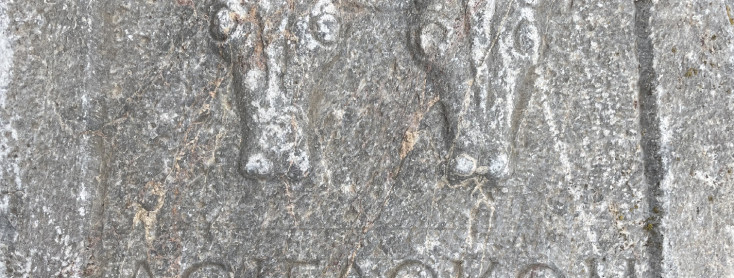
New Votive Inscriptions from Eskişehir Museum
 Necmettin ERAYDIN
Ahmet TÜRKAN
LIBRI XII (2026) 15-25
Received: 09.04.2026 | Accepted: 02.05.2026
DOI: 10.5281/zenodo.20161691
Online Publication Date: 14.05.2026


Abstract: This article presents the epigraphic and historical analysis of seven votive inscriptions preserved in the courtyard of the Eskişehir Eti Archaeology Museum. Although these inscriptions were identified within the borders of Eskişehir Province, their exact findspots remain unknown. It is therefore assumed that the objects may originate from the territories of settlements located within the provincial boundaries that existed at the time the inscriptions were produced; where necessary, the inscriptions have been evaluated within their own internal context. The first inscription was dedicated to the “Just Gods” (Theoi Dikaioi) by a komarkhes and priest of a settlement. Although parallels associated with Hosios kai Dikaios are known, this expression is attested here for the first time in the region as denoting a group of deities. The following three inscriptions are dedicated respectively to Hosios kai Dikaios, Theos Hypsistos, and Men. The fifth inscription is a fragment dedicated by the inhabitants of Doiga. The sixth inscription is dedicated to the local deity of a settlement named Dobana. They are introduced into the literature as two new toponyms. The final inscription is likewise fragmentary and preserves only part of the name of the dedicator. All inscriptions are dated to the 2nd–4th centuries CE and reflect the religious diversity of the Eskişehir region in antiquity.
Keywords: Theoi Dikaioi, Men, Theos Hypsistos, Hosios kai Dikaios, Komarkhes, Doiga
Öz: Bu makale, Eskişehir Eti Arkeoloji Müzesi bahçesinde muhafaza edilen yedi adak yazıtının epigrafik ve tarihsel analizini sunmaktadır. Söz konusu yazıtlar Eskişehir ili sınırları içerisinde tespit edilmiş olmakla birlikte, kesin buluntu yerleri bilinmemektedir. Bu nedenle eserlerin, il sınırları içinde yer alan ve yazıtların üretildiği dönemde varlık gösteren yerleşimlerden herhangi birinin hâkimiyet alanına ait olabileceği varsayılmış; gerekli durumlarda ise yazıtlar kendi iç bağlamları içerisinde değerlendirilmiştir. Yazıtlardan ilki, bir yerleşimin komarkhes’i ve rahibi tarafından “adil tanrılara” (Theoi Dikaioi) adanmıştır. Bu ifade, daha önce Hosios kai Dikaios ile ilişkili örnekler bilinmekle birlikte, bir tanrı grubunu niteleyecek şekilde bölgede ilk kez belgelenmektedir. Bunu izleyen üç yazıt sırasıyla Hosios kai Dikaios, Theos Hypsistos ve Men için düzenlenmiştir. Beşinci yazıt bir fragman olup Doiga sakinleri tarafından adanmıştır. Altıncı yazıt, Dobana adlı yerleşimin yerel tanrısına ithaf edilmiştir. Bu isimler iki yeni toponim olarak literatüre kazandırılmaktadır. Son yazıt ise yine bir fragman olup yalnızca adayanın isminin bir kısmı korunabilmiştir. Tüm eserler MS 2–4. yüzyıllar arasına tarihlenmekte olup Eskişehir bölgesinin antik çağdaki dinsel çeşitliliğini ortaya koymaktadır.
Anahtar sözcükler: Theoi Dikaioi, Men, Theos Hypsistos, Hosios kai Dikaios, Komarkhes, Doiga
Akyürek Şahin N. E. & Uzunoğlu H. 2019, “Neue Inschriften aus dem Museum von Eskişehir”. Gephyra 18, 137-191.
Akyürek Şahin N. E. & Uzunoğlu H. 2020, “Neue Weihungen an Hosios Kai Dikaios aus dem Museum von Eskişehir”. Gephyra 19, 189-230.
Akyürek Şahin N. E. & Uzunoğlu H. 2021, “Neue Inschriften aus dem phrygischen Hochland”. Gephyra 21, 177-197.
Akyürek Şahin N. E. 2007, “Neue Votivsteine aus dem Museum von Afyon”. Gephyra 4, 1-14.
Ameling W. 2005, “Komarkhes”. BNP 7, 87-88.
Boyana H. 2019, “Phrygia Epiktetos’ta Men Kültü”. Ankara Üniversitesi SBD 10, 66-80.
Dökü F. E. & Kileci Ş. 2022, “Ares Reliefs and a New Votive Inscription to Ares in the Rural Highlands of Kabalis / Kabalia”. Adalya 25, 105-124.
Dökü F. E. & Kileci Ş. 2023, “Rock Reliefs of Zeus and his Thunderbolt in the High Plateau Settlements of Kabalis/Kabalia”. Anadolu Anatolia 49, 73-96.
Drew-Bear T., C. M. Thomas & M. Yıldızturan 1999, Phrygian Votive Steles. Ankara.
Erten E. 2023, “Zwei neue Inschriften aus Dorylaion”. Libri 9, 1-12.
Gökalp N. & Akdoğu Arca E. N. 2009, “Antalya’dan Yeni Adak Yazıtları”. Adalya 12, 261-275.
Güney H. 2018, “New Inscriptions from Northeast Phrygia: The Cult of Hosios and Dikaios”. Gephyra 15, 101-117.
İznik E. 2021, “MS II ve III. Yüzyıllarda (Roma Döneminde) Dorylaion (Eskişehir) ve Nacolea’daki (Seyitgazi) Dinsel Yapı”. OANNES 3/2, 505-534.
Körte A. 1897, “Radet, En Phrygie”. GGA 159/5, 386-416.
Lane E. N. 1971, Corpus Monumentorum Religionis Dei Menis (CMRDM), Vol. I: The Monuments and Inscriptions (Études préliminaires aux religions orientales dans l’Empire romain 19). Leiden.
Lane E. N. 1976, Corpus Monumentorum Religionis Dei Menis (CMRDM), Vol. III: Interpretations and Testimonia (Études préliminaires aux religions orientales dans l’Empire romain 19). Leiden.
Lochman T. 2003, Studien zu kaiserzeitlichen Grab- und Votivereliefs aus Phrygien. Basel.
Mitchell S. 1999, “The Cult of Theos Hypsistos between Pagans, Jews, and Christians”. Eds. P. Athanassiadi & M. Frede, Pagan Monotheism in Late Antiquity. Oxford, 81-148.
Mitchell S. 2010, “Further Thoughts on the Cult of Theos Hypsistos”. Eds. S. Mitchell & P. Van Nuffelen, One God: Pagan Monotheism in the Roman Empire. Cambridge, 167-208.
Preisigke F. 1921, “Komarkhes”. RE 21, col. 1129-1131.
Prikhodko E. V. 2023, “Суровые боги» становятся «справедливыми богами», или об одном местном культе высокогорий Кибиратиды, Милиады и Северной Ликии”. Indo-European Linguistics and Classical Philology 27/2, 946-994.
Ramsay W. M. 1882, “Prymnessos and Metropolis”. MDAI(A) 7, 126-145.
Ramsay W. M. 1887, “The Cities and Bishoprics of Phrygia (Continued)”. JHS 8, 461-519.
Ricl M. 1991, “Hosios kai Dikaios. Epithets of the Divine Justicer in the Lydian-Phrygian Context (Part I)”. EA 18, 1-70.
Ricl M. 1992a, “Hosios kai Dikaios. Epithets of the Divine Justicer in the Lydian-Phrygian Context (Part II)”. EA 19, 71-103.
Ricl M. 1992b, “Hosios kai Dikaios. Epithets of the Divine Justicer in the Lydian-Phrygian Context (Part III)”. EA 20, 95-147.
Smith T. J. 1997, “Votive Reliefs from Balboura and Its Environs”. Anatolian Studies 47, 3–49.
Smith T. J. 2011, “Highland Gods: Rock-Cut Votive Reliefs from the Pisidian Survey”. Anatolian Studies 61, 133–150.
Uzunoğlu H. & Akyürek Şahin N. E. 2024, “Eine Neue Inschrift aus dem Territorium von Nikaia”. EA 55, 123-145.
Necmettin ERAYDIN
Asst. Prof., Eskişehir Anadolu University, Faculty of Humanities, Department of Archaeology, Eskişehir, Türkiye. necmi.eraydin@gmail.com
Ahmet TÜRKAN
Assoc. Prof., Eskişehir Osmangazi University, Faculity of Humanities and Social Science, Department of History, Eskişehir, Türkiye. aturkan@ogu.edu.tr