

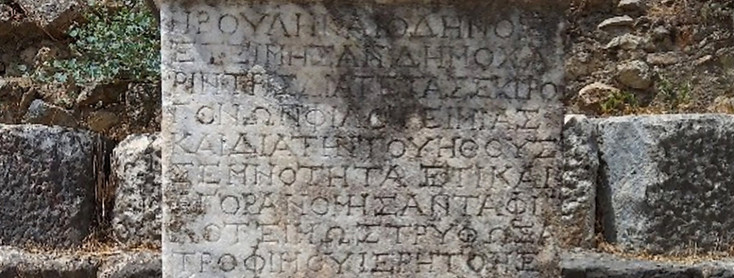
A New Honorific Inscription from Magnesia ad Maeandrum

LIBRI XII (2026) 1-13
Received: 30.03.2026 | Accepted: 19.04.2026
DOI: 10.5281/zenodo.19704468
Online Publication Date: 23.04.2026


Abstract: This study presents a newly discovered inscription from Magnesia ad Maeandrum, found in 2021 and dated to the late 1st century CE or early 2nd century CE. The text preserves the public actions of a woman named Tryphosa, who honoured the memory of her husband Democharis through gestures of civic generosity and religious responsibility. The boule and the demos honoured Democharis for his inherited civic standing, the dignity of his character and his service as agoranomos. After his death, Tryphosa, identified as his wife and as a priestess, undertook several initiatives that affected the civic community at large. She set up a monument in his honour, financed distributions of olive oil in the gymnasia and provided funds for the philosebastos boule in accordance with his instructions. The inscription places commemoration, religious office and civic benefaction within the same public setting and makes clear that Tryphosa was the central figure in turning the memory of Democharis into visible civic action.
Keywords: Tryphosa, Democharis, Oil, Agoranomos, Priestess, Magnesia ad Maeandrum
Öz: Bu çalışma, Magnesia ad Maeandrum’da 2021 yılında bulunmuş ve MS 1. yüzyılın sonları ile 2. yüzyılın başlarına tarihlenen yeni bir yazıtı tanıtmaktadır. Metin, Tryphosa adlı bir kadının, eşi Demokharis’in hatırasını kent yaşamına dokunan hayır işleri ve dinsel sorumluluk çerçevesinde nasıl yaşattığını göstermektedir. Boule ile demos, Demokharis’i ailesinden gelen yurttaşlık itibarı, karakterinin saygınlığı ve agoranomos olarak yürüttüğü görevi nedeniyle onurlandırmaktadır. Onun ölümünden sonra, hem eşi hem de rahibe olarak tanımlanan Tryphosa, kenti doğrudan ilgilendiren çeşitli girişimlerde bulunmaktadır. Kocasının anısına bir anıt diktirmiş, gymnasion’larda zeytinyağı dağıtımını finanse etmiş ve onun vasiyeti doğrultusunda philosebastos boule için maddi kaynak sağlamıştır. Yazıt; anma geleneğini, dini makamı ve kamusal hayırseverliği aynı kamusal çerçeve içine yerleştirmekte ve Tryphosa’nın, Demokharis’in hatırasını görünür bir kamusal eyleme dönüştürmede merkezi figür olduğunu açıkça ortaya koymaktadır.
Anahtar sözcükler: Tryphosa, Demokharis, Yağ, Agoranomos, Rahibe, Magnesia ad Maeandrum
Adak M. 2005, “Altes und Neues zu den Eliten von Kos und Magnesia am Mäander in iulisch-claudischer Zeit”. Eds. S. Aneziri, N. Giannakopoulos, C. Kokkinia, P. Paschidis & S. Psoma, Εἰρηνάρχης, Essays on Politics, Institutions and Society in the Greek and Roman World in Honour of Kostas Buraselis. Μελετήματα 91. Athens, 55-81.
Amouretti M. C. 1986, Le pain et l’huile dans la Grèce antique. Paris.
Ancona R. & Tsouvala G. 2021, New Directions in the Study of Women in the Greco-Roman World. Oxford.
Augier M. 2017 (Trans. S. A. Clio), “Giving a Name to Priestesses in Ancient Greece (Fifth to First Century BCE)”. Women, Gender, History 45/1, 33-59.
Capelle J. 2021, “Le « Nouveau théâtre » : une nouvelle inscription de Magnésie du Méandre”. REG 134/2, 413-462.
Connelly J. B. 2007, Portrait of a Priestess, Women and Ritual in Ancient Greece. Princeton.
Cooley A. 2012, “From Document to Monument: Inscribing Roman Official Documents in the Greek East”. Eds. J. Davies & J. Wilkes, Epigraphy and the Historical Sciences (Proceedings of the British Academy 177). Oxford, 159-182.
Diggle J., B. Fraser, P. James, O. Simkin, A. Thompson & S. Westripp 2021, The Cambridge Greek Lexicon. Vol. 1 A-I. Cambridge.
Dirven L., M. Icks & S. Remijsen 2023, The Public Lives of Ancient Women (500 BCE–650 CE). Boston.
Ellison M. D., C. G. Taylor & C. Osiek 2021, Material Culture and Women’s Religious Experience in Antiquity: An Interdisciplinary Symposium. Lanham.
Foley H. P. 1992, Reflections of Women in Antiquity. London.
Fröhlich P. 2009. “Les activités évergétiques des gymnasiarques à l’époque hellénistique tardive: la fourniture de l’huile”. Ed. O. Curty, L’huile et l’argent. Gymnasiarchie et évergétisme dans la Grèce hellénistique. Fribourg (Suisse), 57-94.
Gauthier P. 1985, Les cités grecques et leurs bienfaiteurs (IVe–Ier s. av. J.-C.). Paris.
Gilles G., C. Frank, C. Plastow & L. Webb 2024, Female Agency in the Ancient Mediterranean World. Liverpool.
Hagel S. & Tomaschitz K. 1998, Repertorium der westkilikischen Inschriften, Nach den Scheden der Kleinasiatischen Kommission der Österreichischen Akademie der Wissenschaften. Vienna.
Hawley R. & Levick B. 1995, Women in Antiquity: New Assessments. London.
Heller A. 2011, “D’un Polybe à l’autre: statuaire honorifique et mémoire des ancêtres dans le monde grec d’époque impériale”. Chiron 41, 287-312.
Hemelrijk E. & Woolf G. 2013, Women and the Roman City in the Latin West. Leiden.
Hemelrijk E. 1999, Matrona Docta: Educated Women in the Roman Elite and Their Benefactions. Leiden.
Hemelrijk E. 2015, Hidden Lives, Public Personae: Women and Civic Life in the Roman West. Oxford.
Hemelrijk E. 2021, Women and Society in the Roman World, A Sourcebook of Inscriptions from the Roman West. Cambridge.
James S. L. & Dillon S. A. 2012, A Companion to Women in Ancient World. Malden.
Kirbihler F. 2019, “Les prêtresses d’Artémis à Éphèse (Ier siècle av. J.-C.–III e siècle apr. J.-C.) ou comment faire du neuf en prétendant restaurer un état ancien?”. Ed. S. Lalanne, Femmes grecques de l’Orient romain. Besançon, 21-79.
Kraemer R. S. 2004, Women’s Religions in the Greco-Roman World: A Sourcebook. Oxford.
MachLachlan B. 2012, Women in Ancient Greece: A Sourcebook. London.
Marek C. 2003, Pontus et Bithynia. Die römischen Provinzen im Norden Kleinasiens. Mainz am Rhein.
McLean B. H. 2005, An Introduction to Greek Epigraphy of the Hellenistic and Roman Periods: From Alexander the Great to the Reign of Constantine (323 BC-AD 337). Ann Arbor.
Mitchell S. 2005. “Olive Cultivation in the Economy of Roman Asia Minor”. Eds. S. Mitchell & C. Katsari, Patterns in the Economy of Roman Asia Minor. Swansea, 83-113.
Montanari F. 2015, The Brill Dictionary of Ancient Greek. Leiden.
Nelson S. M. 2007, Women in Antiquity, Theoretical Approaches to Gender and Archaeology. Lanham.
Papakonstantinou Z. 2019, Sport and Identity in Ancient Greece. New York.
Price S. 1984, Rituals and Power: The Roman Imperial Cult in Asia Minor. Cambridge.
Quaß F. 1993, Die Honoratiorenschicht in den Städten des griechischen Ostens. Stuttgart.
Rantala J. 2019. Gender, Memory, and Identity in the Roman World. Amsterdam.
Schultz C. E. 2006, Women’s Religious Activity in the Roman Republic. Chapel Hill.
Siekierka P., K. Stebnicka & A. Wolicki 2021, Women and the Polis: Public Honorific Inscriptions for Women in the Greek Cities from the Late Classical to the Roman Period. Berlin.
Stavrianopoulou E. 2024, “Women in Civic Societies”. Eds. M. Hallmannsecker & A. Heller, The Oxford Handbook of Greek Cities in the Roman Empire. Oxford, 341-356.
Strubbe J. H. M. 1987. “The Sitonia in the Cities of Asia Minor under the Principate I”. EA 10, 45-82.
Strubbe J. H. M. 1989. “The Sitonia in the Cities of Asia Minor under the Principate II”. EA 13, 99-122.
Theodorou E. 2023, Das Amt des Agoranomos in Griechenland und Kleinasien unter besonderer Berücksichtigung der Kaiserzeit (27 v. Chr.–3. Jh. n. Chr.). Unpublished Doctoral Dissertation, University of Vienna. Vienna.
van Bremen R. 1996, The Limits of Participation: Women and Civic Life in the Greek East in the Hellenistic and Roman Periods. Amsterdam.
Woodhead A. G. 1959, The Study of Greek Inscriptions. Cambridge.
Zuiderhoek A. 2009, The Politics of Munificence in the Roman Empire: Citizens, Elites and Benefactors in Asia Minor. Cambridge.
Tolga UZUN
Dr., Independent Researcher, Yeni Mah. 435 Sok. No: 5B, 07980, Kemer, Antalya, Türkiye. totolga7@gmail.com