

A New Agonistic Epigram from Synnada: Antigonos the Trumpeter
 M. Ertan YILDIZ
N. Eda AKYÜREK ŞAHİN
LIBRI XII (2026) 27-39
Received: 07.04.2026 | Accepted: 06.05.2026
DOI: 10.5281/zenodo.20266542
Online Publication Date: 21.05.2026


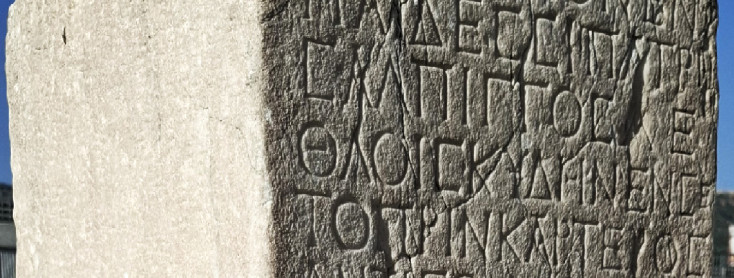
Abstract: The subject of this article is a fifteen-line inscription (Figs. 1-4) on the front face of a marble block discovered in the Şuhut district of Afyon and currently preserved in the Afyon Museum. The findspot of the stone belonged to the territory of the city of Synnada, located in Phrygia during antiquity. The inscription is an agonistic epigram consisting of three distichs honoring a successful trumpeter. In the epigram, a trumpeter named Antigonos is praised. He is known to have participated in trumpet competitions and achieved success while still a child. In later periods, he also gained victories in the Actian and Pythian games. It is emphasized that Antigonos glorified his homeland – which is not named in the epigram but is likely Synnada based on the findspot – through his achievements. We include this inscription within the group of agonistic inscriptions known from Synnada to date, some of which are also in the form of epigrams. This marks the first time a trumpeter has been documented in Synnada. Based on current epigraphic and numismatic evidence, the only major festival and games identified in Synnada to date is the great festival known as the “Hadrianeia Panathenaia”. This inscription honoring the trumpeter was also likely erected during a celebration of the Hadrianeia Panathenaia agon in the city. Due to its letterforms and content, the epigram can be dated to the same period as similar epigrams from Synnada, such as those of Thallos and Aristainetos (see the appendix) -namely, the first half of the 3rd century CE.
Keywords: Agonistic Epigram, Afyon Museum, Synnada, Pythia, Actia, Salpinktes/Trumpeter
Öz: Afyon’un Şuhut ilçesinde bulunmuş ve günümüzde Afyon Müzesi’nde korunan mermer bir blok taşın ön yüzündeki on beş satırlık bir yazıt (Figs. 1-4) bu makalenin konusunu oluşturmaktadır. Taşın bulunduğu yer, antikçağda Phrygia’da yer alan Synnada kentinin topraklarına aitti. Yazıt başarılı bir trompetçinin onurlandırıldığı üç distykhondan oluşan agonistik bir epigramdır. Epigramda Antigonos isimli bir trompetçi övülmektedir. Bu kişinin daha çocukken trompet yarışmalarına katıldığı ve başarılar kazandığı anlaşılmaktadır. Daha sonraki zamanlarda Aktia ve Pythia oyunlarında da zaferler elde etmiştir. Antigonos’un adı epigramda verilmeyen ama buluntu yerinden dolayı Synnada olması muhtemel olan vatanını başarılarıyla yücelttiği vurgulanmaktadır. Bu yazıtı bugüne kadar Synnada’dan bilinen ve bazıları da epigram şeklinde olan bir grup agonistik yazıt grubunun içine dahil ediyoruz. Synnada’dan ilk kez bir trompetçi belgelenmektedir. Mevcut epigrafik ve nümismatik belgelere dayanarak Synnada’da bugüne kadar tespit edilmiş olan tek bayram “Hadrianeia Panathenaia” adıyla bilinen büyük bayram ve oyunlardır. Trompetçiyi onurlandıran bu yazıt da olasılıkla kentteki bir Hadrianeia Panathenaia agonu sırasında dikilmiş olmalıdır. Epigram harf karakterleri ve içeriği nedeniyle Synnada’daki Thallos ve Aristainetos epigramları gibi (bk. ekler kısmı) benzer epigramlarla aynı döneme, yani MS 3. yüzyılın ilk yarısına tarihlenebilir.
Anahtar sözcükler: Agonistik Epigram, Afyon Müzesi, Synnada, Pythia, Aktia, Trompetçi
Aneziri S. 2003, Die Vereine der Dionysischen Techniten im Kontext der hellenistischen Gesellschaft. Untersuchungen zu Geschichte, Organisation und Wirkung der hellenistischen Technitenvereine (Historia Einzelschriften 163). Stuttgart.
Aneziri S. 2014, “Stiftungen für sportliche und musische Agone”. Eds. K. Harter-Uibopuu & Th. Kruse, Sport und Recht in der Antike Beiträge zum 2. Wiener Kolloquium zur Antiken Rechtsgeschichte 27.-28.10.2011. Wien.
Baytak İ. 2025, “Synnada ve Çevresi Yüzey Araştırması 2023”. AST 40/2, 403-431.
Begass Chr. 2025, Zwischen Stadt und Stadion, Die Agonothesie der griechisch-römischen Welt in Hellenismus und Kaiserzeit. Stuttgart.
Belke K. & Mersich N. 1990, Phrygien und Pisidien (Tabula imperii Byzantini 7). Wien.
Bowyer C. S. 2016, Echoes of the salpinx: the trumpet in ancient Greek culture. Unpublished Doctoral Thesis, Royal Holloway. University of London.
Cerqueira F. V. 2017, “A trombeta e os jogos”. Revista do Museu de Arqueologia e Etnologia 29, 75-99.
Crowther N. B. 1988, “The Age-Category of Boys at Olympia”. Phoenix 42/4, 304-308.
Crowther N. B. 1994, “The Role of Heralds and Trumpeters at Greek Athletic Festivals”. Nikephoros 7, 135-155.
Crowther N. B. 2004. “The Role of Heralds and Trumpeters at Greek Athletic Festivals”. Ed. N. B. Crowther, Athletika: Studies on the Olympic Games and Greek Athletics (Nikephoros Beihefte, Nr. 11). Hildesheim (Nachdruck), 183-201.
Drew-Bear Th. & Sacco G. 2006-2007, “Epigrammi agonistici et notabili di Synnada”. AION (archeol) 13-14, 253-281.
Drew-Bear Th. 2004/2005. “Phrygia ve Pisidia’da Yeni Epigrafik Yüzey Araştırmaları”. AST 22/2, 213-218.
Eraydın N. 2021, Epigrafik, Nümizmatik ve Edebi Belgeler Işığında Synnada Tarihi. Unpublished Doctoral Dissertation. Akdeniz University, Antalya.
Frisch P. 1986, Zehn agonistische Papyri. Opladen.
Golden M. 2004, Sport in the Ancient World from A to Z. London.
Hale J. R. 2003, “Salpinx” and “salpinktes”: “Trumpet and Trumpeter in Ancient Greece”. Eds. A. F. Basson & J. Dominik, Literature, Art, History: Studies on Classical Antiquity and Tradition in Honour of W. J. Henderson. Frankfurt, 267-273.
Hoffmann V. 2017, “Hadrian und die Finanzierung von Siegerstatuen für Trompeter und Herolde bei den ephesischen Olympia (SEG 56, 1359, ZZ. 40-43)”. Philia 3, 79-96.
Jones C. P. 2007, “Three New Letters of the Emperor Hadrian”. ZPE 161, 145-156.
Lane E. N. 1971, Corpus Monumentorum Religionis Dei Menis (CMRDM) I. (EPRO 19,1). Leiden.
Lehner M. F. 2004, Die Agonistik im Ephesos der römischen Kaiserzeit. Unpublished Doctoral Thesis, LMU München (https://edoc.ub.uni-cmuenchen.de/3261/1/Lehner_Michael.pdf).
Leschhorn, W. 1998. “Die Verbreitung von Agonen in den östlichen Provinzen des Römischen Reiches”. Ed. M. Lämmer, Colloquium “Agonistik in der römischen Kaiserzeit”, Landhaus Rothenberge bei Münster, 25–27 Oktober 1995 (= Stadion 24/1). St. Augustin, 31–57.
Mazzini L. 2020. Triggered Identities and Imperial Power? Macedonian Label Re/use by Civic Communities in Roman Lydia and Phrygia. Ph.D. diss., University of Exeter. Exeter, UK.
Merisio E. N. 2020-2021, “Giochi di parole ed evergetismo in un’iscrizione metrica di Synnada: l’epigramma per Kynegia”. Incontri di filologia classica 20, 205-214.
Merisio E. N. 2024, Le iscrizioni metriche greche della Frigia orientale. Edizione, traduzione e commento (Texte und Kommentare 73). Berlin&Boston.
Mitchell S. 1990, “Festivals, Games and Civic Life in Roman Asia Minor”. JRS 80, 183-193.
Petermandl W. 2012, “Age-categories in Greek Athletic Contests”. Nikephoros YOG, 85-93.
Petzl G. & Schwertheim E. 2006, Hadrian und die dionysischen Künstler: Drei in Alexandria Troas neugefundene Briefe des Kaisers an die Künstler-Vereinigung (Asia Minor Studien 58). Bonn.
Samitz Chr. 2018, “Neue agonistische Inschriften aus Ephesos”. ÖJh 87, 373-400.
Staab G. 2018, Gebrochener Glanz. Klassische Tradition und Alltagswelt im Spiegel neuer und alter Grabepigramme des griechischen Ostens. Berlin&Boston.
Strasser J. -Y. 2010, “”Qu’on fouette les concurrents…” À propos des lettres d’Hadrien retrouvées à Alexandrie de Troade”. REG 123/2, 585-622.
Uzunoğlu H. & Dinç M. 2026, “New Inscriptions from Akmoneia”. Gephyra 31, forthcoming.
Wörrle M., 1988, Stadt und Fest im kaiserzeitlichen Kleinasien. Studien zu einer agonistischen Stiftung aus Oinoanda (Vestiga Bd. 39). München.
Xanthoulis N. 2006, “The Salpinx in Greek Antiquity”. International Trumpet Guild Journal 31, 39-45.
Kalıcı Bağlantı Adresi: http://www.libridergi.org/2026/lbr-0356
M. Ertan YILDIZ
Assoc. Prof. Dr., Akdeniz University, Faculty of Humanities and Social Sciences, Department of Ancient Languages and Cultures, Antalya, Türkiye. ertanyildiz@akdeniz.edu.tr
N. Eda AKYÜREK ŞAHİN
Prof. Dr., Akdeniz University, Faculty of Humanities and Social Sciences, Department of Ancient Languages and Cultures, Antalya, Türkiye. edasahin@akdeniz.edu.tr