

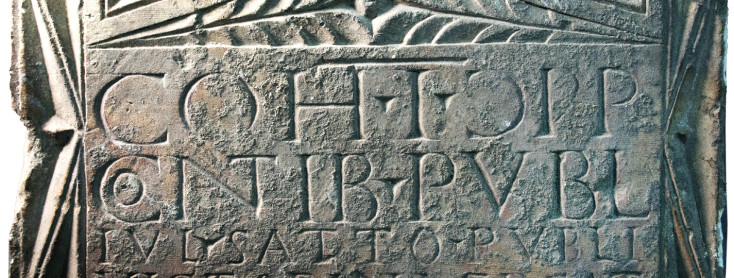
A New Latin Building Inscription from the Gaziantep Zeugma Mosaic Museum

LIBRI XII (2026) 41-48
Geliş Tarihi: 22.05.2026 | Kabul Tarihi: 15.06.2026
DOI: 10.5281/zenodo.21040426
Elektronik Yayın Tarihi: 29.06.2026


Abstract: This study examines a previously unpublished Latin inscription preserved in the stone artifacts depot of the Gaziantep Zeugma Mosaic Museum. Although the exact context is unclear, the inscription must have been erected to commemorate a construction activity in which Publius Iulius Satto and Publius Victorinius Mercator, who served as contubernales in the Roman army, were likely involved. The inscription records that these individuals served in the first cohors within the centuria of the primus pilus. The tradition of naming centuriae after their commanders (centurio) disappeared from the 3rd century CE onwards; instead, as is the case in this inscription, they began to be named according to the duty title within the centuria. Since this title is given as primus pilus in the inscription, it is understood that these two contubernales, Satto and Mercator, were in the first centuria of the first cohors, the most prestigious unit in the legion. The inscription does not specify to which legion this unit was attached; however, it was most probably one of the legions temporarily stationed in the region and attested by numerous stamped tiles. Both the Celtic origin of the cognomen Satto and the exclusive concentration of the name Victorinius in the Rhineland point to a likely Gallo-Germanic origin for these contubernales. Based on the naming convention of the centuria, the inscription is dated to the 3rd century CE.
Keywords: Latin Inscriptions, Primus pilus, Cohors Prima, Zeugma Mosaic Museum, Roman Army
Öz: Bu çalışmada Gaziantep Zeugma Mozaik Müzesi’nin taş eserler deposunda muhafaza edilen ve daha önce yayımlanmamış bir Latince yazıt incelenmektedir. Hangi bağlamda kaleme alındığı tam olarak belli olmasa da yazıt, Roma ordusunda contubernalis olarak hizmet veren Publius Iulius Satto ve Publius Victorinius Mercator’un olasılıkla dâhil oldukları bir inşa faaliyetinin anısına dikilmiş olmalıdır. Yazıtta bu kişilerin, ilk cohors bünyesindeki primus pilus’un centuria’sında görevli oldukları kayıtlıdır. Centuria’ların, komutanlarının (centurio) adlarına izafeten adlandırılma geleneği MS 3. yüzyıldan itibaren ortadan kalkmış ve bunun yerine, bu yazıtta olduğu gibi centuria içindeki görev unvanına göre isimlendirilmeye başlanmıştır. Bu unvan da yazıtta primus pilus olarak verildiğinden, Satto ve Mercator adlı bu iki contubernalis’in lejyondaki en prestijli birim olan ilk cohors’un ilk centuria’sında bulundukları anlaşılmaktadır. Bu birimin hangi lejyona bağlı olduğu bilgisi yazıtta yer almamaktadır; ancak bu lejyon, büyük olasılıkla bölgede geçici görevle bulunan ve çok sayıda damgalı kiremitle belgelenen lejyonlardan biri olmalıdır. Satto cognomen’inin Keltçe kökeni ve Victorinius nomen’inin Ren Bölgesi’ndeki yoğunluğu, bu contubernales için muhtemel bir Galya-Germen kökenine işaret etmektedir. Yazıt, centuria’nın adlandırılma şeklinden dolayı MS 3. yüzyıla tarihlendirilmektedir.
Anahtar sözcükler: Latince Yazıtlar, Primus pilus, Cohors Prima, Zeugma Mozaik Müzesi, Roma Ordusu
Alföldy G. 1969, Die Personennamen in der römischen Provinz Dalmatia. Heidelberg.
Bowman A. K. & Thomas J. D. 1983, Vindolanda: The Latin Writing-Tablets. With Contributions by J. N. Adams and Richard Tapper (Britannia Monograph Series 4). London.
Bruun Chr. 1988. “Caligatus, tubicen, optio carceris and the Centurions’ Positions; Some Remarks on an Inscription in ZPE 71 (1988)”. Arctos 22, 23-40.
Cupcea G. & Zăgreanu R. 2018, “Guarding the Eagle. Soldier Membership in the First Cohort of the Legion in a Revisited Inscription from Potaissa”. Acta Musei Napocensis 55/1, 141-150.
Dean L. R. 1916, A Study of the Cognomina of Soldiers in the Roman Legions. Unpublished Doctoral Thesis, Princeton University. Princeton, N. J.
Dobson B. 1974, “The Significance of the Centurion and ‘Primipilaris’ in the Roman Army and Administration”. ANRW II.1, 393-434.
Evans D. E. 1968, “Nomina Celtica, I. Catamantaloedis, docnimarus, satigenus”. Etudes Celtiques 12/1, 195-200.
Faure P. 2013, “Entre épigraphie et archéologie: la IIe légion parthique et les structures des légions romaines”. Eds. F. Bertholet & Ch. Schmidt Heidenreich, Entre archéologie et épigraphie. Nouvelles perspectives sur l’armée romaine. Bern, 17-77.
Görkay K. 2017, “Zeugma Lejyon Yerleşkesi: Yeni Araştırmalar, Sonuçlar ve Ön Değerlendirmeler”. Anadolu 43, 147-178.
Hartmann M. & Speidel M. A. 2003, “The Roman Army at Zeugma: Recent Research Results”. Ed. J. H. Humphrey, Zeugma Interim Reports. Portsmouth, 100-126.
Hartmann M. & Speidel M. A. 2013, “Military Installations at Zeugma: An Overview of the Swiss Archaeological Investigations, 2001-2003”. Ed. W. Aylward, Excavations at Zeugma. Conducted by Oxford Archaeology. Vol. III, Los Altos, California, 381-392.
Hatt J. J. 1964, “Saturninus et Satto. Observations sur l’origine et la diffusion de ces noms en Gaule”. RAE 15, 327-329.
Holder A. 1904, Alt-celtischer Sprachschatz. Zweiter Band: I – T. Leipzig.
Kajanto I. 1965, The Latin Cognomina. Helsinki & Helsingfors.
Kakoschke A. 2021, Die Personennamen in den römischen Provinzen Germania inferior und Germania superior. Band 1: Gentilnomina ABILIUS–VOLUSIUS. Göttingen.
Kakoschke A. 2025, Die Personennamen in der römischen Provinz Gallia Lugdunensis. Hannover & Stuttgart.
Lendon J. E. 2006, “Contubernalis, Commanipularis, and Commilito in Roman Soldiers’ Epigraphy: Drawing the Distinction”. ZPE 157, 270-276.
Malzbender T., D. Gelb & H. Wolters 2001. “Polynomial Texture Maps”. Proceedings of the 28th Annual Conference on Computer Graphics and Interactive Techniques. Los Angeles, 519-528. Doi: 10.1145/3832 59.383320.
Mitford T. B. 1988, “Further Inscriptions from the Cappadocian Limes”. ZPE 71, 167-178.
Omar I. 2017, Les légions romaines de la province de Syrie sous le Haut-Empire d’après les inscriptions latines et grecques. Unpublished Doctoral Thesis, Université de recherche Paris Sciences et Lettres. Paris.
RIB I = Collingwood R. G. & Wright R. P. 1965, The Roman Inscriptions of Britain, vol. I: Inscriptions on Stone. Oxford.
Speidel M. A. 1998, “Legio IIII Scythica, its Movements and Men”. Ed. D. L. Kennedy, The Twin Towns of Zeugma on the Euphrates. Rescue Work and Historical Studies. Portsmouth, 163-204.
Speidel M. A. 2009a, “Legio Operosa Felix”. Ed. M. A. Speidel, Heer und Herrschaft im Römischen Reich der Hohen Kaiserzeit. Stuttgart, 249-253.
Speidel M. A. 2009b, “Auf kürzestem Weg und gut verpflegt an die Front. Zur Versorgung pannonischer Expeditionstruppen während der severischen Partherkriege”. Ed. M. A. Speidel, Heer und Herrschaft im Römischen Reich der Hohen Kaiserzeit, Stuttgart, 255-271.
Speidel M. A. 2015, “The Roman Army”. Eds. Chr. Bruun & J. Edmondson, The Oxford Handbook of Roman Epigraphy. Oxford, 319-344.
Speidel M. P. 1983, “The Centurions’ Titles”. Epigraphische Studien 13, 43-61.
Speidel M. P. 1990, “The Names of Legionary Centuriae”. Arctos 24, 135-137.
TLL IV = Thesaurus Linguae Latinae. Volumen IV: CON – CYVLVS. Leipzig 1906-1909.
Väänänen V. 1966, Le latin vulgaire des inscriptions pompéiennes (3rd ed.). Berlin.
von Domaszewski A. 1908, Die Rangordnung des Römischen Heeres. Bonn.
Weisgerber J. L. 1968, Die Namen der Ubier. Köln & Opladen.
Zair N. 2023, Orthographic Traditions and the Sub-elite in the Roman Empire. Cambridge.
Kalıcı Bağlantı Adresi: http://www.libridergi.org/2026/lbr-0357
Aykan AKÇAY
Res. Assist. Dr., Akdeniz University, Mediterranean Civilizations Research Institute, Antalya, Türkiye. aykanakcay@akdeniz.edu.tr
Hüseyin UZUNOĞLU
Assoc. Prof. Dr., Akdeniz University, Faculty of Letters, Department of Ancient Languages and Cultures, Antalya, Türkiye