

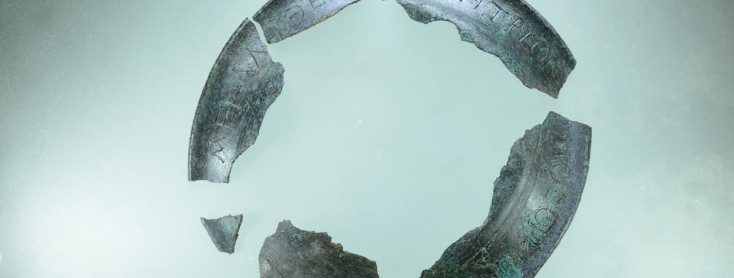
A New Inscribed Bronze Bowl Dedicated to Megale Thea Demeter from Arykanda

LIBRI XII (2026) 49-65
Received: 19.05.2026 | Accepted: 24.06.2026
DOI: 10.5281/zenodo.21134137
Online Publication Date: 11.07.2026


Abstract: This article presents an inscribed bronze votive bowl discovered in 2019 within a building complex associated with the Sebasteion (Room M5) at the acropolis of Arykanda. The multifunctional nature of the building complex, along with the associated finds, indicates that the area served as a hybrid space where ritual practices and daily life intertwined. Dating to the 2nd–3rd centuries CE, the inscribed bowl provides the only evidence to date of the goddess Demeter in the city’s pantheon. The bowl extends the geographical distribution of the cult of Demeter in Lycia eastward and into the interior. The incised inscription on the bowl bears the epithet Megale Thea (Great Goddess), hitherto unattested for Demeter in Lycia. This epithet reflects the rhetoric of religious exaltation prevalent in Roman Imperial Asia Minor. The dedicator, Theo[d]amos, identifies himself as an oikonomos (steward/administrator), suggesting he may have been an official attached to either the city or a cult organisation.
Keywords: Arykanda, Demeter, Megale Thea, Bronze Bowl, Oikonomos
Öz: Makale, 2019 yılında Arykanda akropolisinde, Sebasteion’a bağlı bir yapı kompleksinde (M5 No.lu mekân) keşfedilen yazıtlı bronz bir adak kabını tanıtmaktadır. Yapı kompleksinin çok işlevli doğası, ele geçen buluntularla birlikte, alanın ritüel pratikler ile günlük yaşamın iç içe geçtiği hibrit bir mekân olarak hizmet verdiğini göstermektedir. MS 2.–3. yüzyıllara tarihlenen yazıtlı kap, kentin pantheonunda tanrıça Demeter’e ilişkin şimdiye dek bilinen tek belgeyi sağlamaktadır. Kap, Demeter kültünün Lykia’daki coğrafi dağılımını doğuya ve iç kesimlere doğru genişletmektedir. Kabın üzerine işlenmiş yazıt, Lykia’da Demeter için bugüne dek tespit edilmemiş Megale Thea (Büyük Tanrıça) epitetini taşımaktadır. Bu epitet, Roma İmparatorluk Dönemi Anadolu’sunda yaygın olan dinsel yüceltme retoriğini yansıtmaktadır. Adağı sunan Theo[d]amos, kendisini bir oikonomos (kâhya/idareci) olarak tanımlamakta ve bu durum şahsın ya kente ya da kült örgütüne bağlı bir görevli olabileceğini düşündürmektedir.
Anahtar sözcükler: Arykanda, Demeter, Megale Thea, Bronz Kap, Oikonomos
Aperghis G. G. 2004, The Seleukid Royal Economy: The Finances and Financial Administration of the Seleukid Empire. Cambridge.
Bagnall R. S. 1976, The Administration of the Ptolemaic Possessions Outside Egypt. Leiden.
Bayburtluoğlu C. 2003, Yüksek Kayalığın Yanındaki Yer. İstanbul.
Bayburtluoğlu C. 2006, “Arykanda Tanrıları ve Kültleri”. Eds. K. Dörtlük, B. Varkıvanç, T. Kahya, J. D. Courtils, M. Doğan Alparslan & R. Boyraz, III. Uluslararası Likya Sempozyumu Sempozyum Bildirileri. İstanbul, 61-68.
Belayche N. 2016, “La Mater Magna, Megalè Mètèr?”. Eds. C. Bonnet, V. Pirenne-Delforge & G. Pironti, Dieux des Grecs – Dieux des Romains. Panthéons en dialogue à travers l’ histoire et l’ historiographie. Bruxelles & Rome, 45-59.
Brackertz U. 1976, Zum Problem der Schutzgottheiten griechischer Städte. Berlin.
Chaniotis A. 2010, “Megatheism: The Search for the Almighty God and the Competition of Cults”. Eds. S. Mitchell & P. van Nuffelen, One God. Pagan Monotheism in the Roman Empire. Cambridge, 112-140.
Cole S. G. 1995, “Civic Cult and Civic Identity”. Ed. M. H. Hansen, Sources for the Ancient Greek City-State: Symposium August, 24-27, 1994. Copenhagen, 292-325.
Corsten T. 2005, “Estates in Roman Asia Minor: The Case of Kibyratis”. Eds. S. Mitchell & C. Katsari, Patterns in the Economy of Roman Asia Minor. Swensa, 1-52.
Fernoux H. L. 2004, Notables et élites des cités de Bithynia aux époques hellénistique et romaine (IIIe siècle av. J.-C.-III e siècle ap. J. C.). Lyon.
Frei P. 1990, “Die Götterkulte Lykiens in der Kaiserzeit”. ANRW 2/18.3, 1729-1864.
Frézouls E. 1993, “Les cultes de la Lycie occidentale”. Ed. J. Borchhardt, Akten des II. internationalen Lykien-Symposions. Wien, 203-212.
Gaifman M. 2018, “The Greek Libation Bowl as Embodies Object”. Art History 41/3, 444-465.
Geisau H. V. 1957, “Prokathegetis”. RE XXIII/1, col. 171.
Gerçek H. 2018, “Arykanda Kenti Podyumlu Tapınağı”. Eds. T. Kahya, A. Özdizbay, N. Tüner Önen & M. Wilson, Uluslararası Genç Bilimciler Buluşması II: Anadolu Akdenizi Sempozyumu 04-07 Kasım 2015 Antalya. Antalya, 321-340.
Gignac F. T. 1976, A Grammar of the Greek Papyri of the Roman and Byzantine Periods. Vol. 1. Milano.
Goodrich J. 2012, Paul as an Administrator of God in 1 Corinthians. Cambridge.
Gürgezoğlu A. 2006, Arykanda Konut Mimarisi. Yayımlanmamış Doktora Tezi, Ankara Üniversitesi. Ankara.
Jameson S. 1966, “Two Lycian Families”. Anatolian Studies 16, 125-137.
Kern O. 1901, “Demeter”. RE. vol. IV. cols. 2713-2764.
Kileci Ş. & Tüner-Önen N. 2024, “Restoration Works in Kibyra during the Claudian Period: New Inscriptions, τὰ σεβαστὰ ἔργα of the Lycian Governor Quintus Veranius and New Inscriptions Concerning His Family”. Eds. F. Onur & Ch. Schuler, New Research on Greek Epigraphy in Lycia: Proceedings of the Symposium at Antalya, Türkiye 28-30 March 2022, İstanbul, 123-141.
Kroll J. H. 1982, “The Ancient Image of Athena Polias”. Hesperia Supp. 20, 65-76.
Landvogt P. 1908, Epigraphische Untersuchungen über den Oikonomos: (Ein Beitrag zum hellenistischen Beamtenwesen). Strassburg.
Marek C. & Adak M. 2016, Epigraphische Forschungen in Bithynien, Paphlagonien, Galatien und Pontos. İstanbul.
Martin D. B. 1990, Slavery as Salvation: The Metaphor of Slavery in Pauline Christianity. New Haven.
Mason H. J. 1974, Greek Terms for Roman Institutions: A Lexicon and Analysis. Toronto.
Merkelbach R. & Stauber J. 1996, “Die Orakel des Apollon von Klaros”. EA 27, 1-54.
Özdemir B. Ş. 2016, Tlos Tanrıları ve Kültleri. Unpublished Doctoral Thesis, Akdeniz Üniversitesi. Antalya.
Parker R. 2015, “Public and Private”. Eds. R. Raja & J. Rüpke, A Companion to the Archaeology of Religion in the Ancient World. Hoboken, 71-80.
Petersen E. & von Luschan F. 1889, Reisen im südwestlichen Kleinasien Band II. Reisen in Lykien Milyas und Kibyratis. Wien.
Raja R. & Rüpke J. 2015, “Archaeology of Religion, Material Religion, and the Ancient World”. Eds. R. Raja & J. Rüpke, A Companion to the Archaeology of Religion in the Ancient World. Hoboken, 1-26.
Rebillard E. 2015, “Material Culture and Religious Identity in Late Antiquity”. Eds. R. Raja & J. Rüpke, A Companion to the Archaeology of Religion in the Ancient World. Hoboken, 427-436.
Reumann J. 1958, “Stewards of God: Pre-Christian Religious Application of Oikonomos in Greek”. Journal of Biblical Literature 77/4, 339-349.
Rüpke J. 2007, “Roman Religion — Religions of Rome”. Ed. J. Rüpke, A Companion to Roman Religion. Malden & Oxford, 1-9.
Sancaktar H. 2019, Arykanda Akropolisi Kutsal Alanları ve Kültleri. Ankara.
Sancaktar H. 2023, “Sebasteion Rahibi Konutunda Ele Geçen Sikkeler”. Kairos 1, 17-46.
Schwertheim E. & Schwert N. G. 2018, Epigraphica Lydien, Mysien, Türkei der Sammlung Yavuz Tatış. İzmir.
Tekinalp V. M. & Sancaktar H. 2022, “Arykanda Akropolisi”. Eds. M. Demirel, M. Arslan, S. Atalay, & U. Orhan, Antalya Müzesi 100 Yaşında: Antalya’nın Arkeolojik Mirası. Ankara, 589-607.
Tekinalp V. M., H. Sancaktar , Ş. Yıldırım & F. Seviç 2019, “Arykanda 2018 Yılı Çalışmaları”. KST 41, 87-107.
Uzunoğlu H. & Aydın Tavukçu Z. 2022, “Some Inscriptions from Philadelphia”. Libri 8, 159-166.
van Andringa W. 2015, “The Archaeology of Ancient Sanctuaries”. Eds. R. Raja & J. Rüpke, A Companion to the Archaeology of Religion in the Ancient World. Hoboken, 27-40.
Versnel H. S. 1998, Inconsistencies in Greek and Roman Religion I: Ter Unus. Isis, Dionysos, Hermes. Three Studies in Henotheism. Leiden & Boston – Köln.
Welborn L. L. 2011, An End to Enmity: Paul and the “Wrongdoer” of Second Corinthians. Berlin – Boston.
Ziebarth E. 1937, “Oikonomos”. RE XVII.2, cols. 2118-2119.
Fatih YILMAZ
Res. Asst. Dr., Akdeniz University, Department of Ancient Languages and Cultures, Antalya, Türkiye. fatihyilmaz@akdeniz.edu.tr
Hacer SANCAKTAR
Assoc. Prof., Yozgat Bozok University, Department of Archaeology, Yozgat, Türkiye. hacer.sancaktar@yobu.edu.tr