

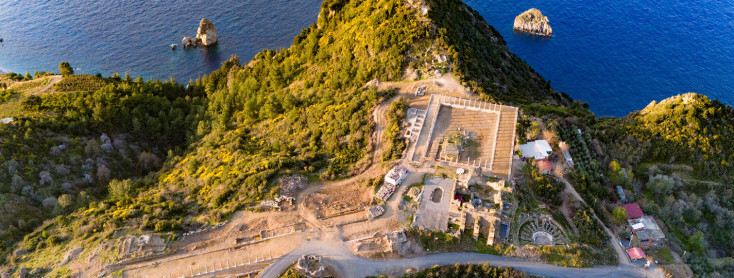
The Themis Leonideios in the Light of a New Inscription

LIBRI XI (2025) 211-233
Received Date: 26.10.2025 | Acceptance Date: 14.11.2025
DOI: 10.5281/zenodo.18030839
Online Publication Date: 23.12.2025


Abstract: A newly discovered inscription from Antiokheia Paralios, commonly known as Antiochia ad Cragum, commemorates an athlete named Aur(elius) Salvianus, who won the pankration competition in the boys’ category during the first celebration of the themis Leonideios, established by Aur(elius) Leonidas. The inscription proves a crucial role in resolving uncertainties surrounding the themis, and significantly enhances the understanding of its nature and scope. It offers fresh interpretations of expressions found in other related inscriptions and it enables more precise inferences regarding the founding process of the themis and the life of its founder, Leonidas. Moreover, it establishes a clear timeline for both the founding and concluding dates of the themis. Additionally, it provides the basis for essential corrections and updates to previously published inscriptions related to the themis Leonideios.
Keywords: Antiochia, Rough Cilicia, Leonidas, Themis Leonideios, Pankration, Salvianus
Öz: Resmi belgelerde Antiokheia Paralios olarak geçen, ancak genel olarak Antiochia ad Cragum adıyla bilinen kentte bulunan yeni bir yazıt, Aur(elius) Leonidas tarafından kurulan themis Leonideios’un ilk kutlamasında, çocuklar kategorisinde pankration yarışmasını kazanan Aur(elius) Salvianus adlı bir sporcuyu onurlandırmaktadır. Bu yazıt, themis Leonideios’a ilişkin belirsizliklerin giderilmesinde kritik bir rol oynamakta; bunun kapsamına, niteliğine ve diğer ilgili yazıtlarda geçen ifadelere dair yeni ve açıklayıcı yorumlar sunmaktadır. Themis’in kuruluş süreci ve kurucusu Leonidas’ın yaşamı hakkında daha kesin çıkarımlar yapılmasına olanak tanımaktadır. Themis’in kuruluş ve sona erme tarihleri için açık ve güvenilir bir zaman çizelgesi oluşturulmasını sağlamaktadır. Themis Leonideios ile ilgili daha önce yayımlanmış yazıtlar üzerinde bazı zorunlu düzeltmeler ve güncellemeler yapılmasını mümkün kılmaktadır.
Anahtar sözcükler: Antiochia, Dağlık Kilikia, Leonidas, Themis Leonideios, Pankration, Salvianus
Altın R. 2022, Roma İmparatorluk Çağı Küçük Asya’sında Özel Şahıs İsmiyle Anılan Agon’lar. Yayımlanmamış Doktora Tezi, Uludağ Üniversitesi, Bursa.
Avcu F. & Uzunoğlu H. 2024, “New Inscriptions from Rough Cilicia”. Adalya 27, 193-211.
Bai S. 2024, “The Subdivision of Boys in the Leonidean Decree (IG V.1.19)”. Mnemosyne 77/1, 75-95.
Baker P. & Thériault G. 2014, “La vie agonistique xanthienne: nouvel apport épigraphique”. Revue des Études Grecques 127/1, 97-118.
Baz F. & Öztürk H. S. 2025, “A New Agonistic Honorific Inscription for Dioteimos from Termessos”. Gephyra 30, 71-78.
Baz F. 2025, “New Honorific and Religious Inscriptions from Colonnaded Street of Termessos”. Libri XI, 131-147.
Bean G. E. & Mitford T. B. 1962, “Sites Old and New in Rough Cilicia”. AnatSt. 12, 185-217.
Bean G. E. & Mitford T. B. 1965, Journeys in Rough Cilicia in 1962 and 1963. Wien.
Bean G. E. & Mitford T. B. 1970, Journeys in Rough Cilicia 1964-1968. Wien.
Blanco-Pérez A. 2016, “Nomenclature and Dating in Roman Asia Minor: (M.) Aurelius/a and the 3rd Century AD”. ZPE 199, 271–293.
Chaniotis A. 2011, “Epigraphic Bulletin for Greek Religion 2008 (EBGR 2008)”. Kernos 24, 205-261.
Couvenhes J.-Ch. 1998, “Le stratège Derkylos, fils d’Autoklès d’Hagnous et l’éducation des paides à Éleusis”. Cahiers du Centre Gustave Glotz 9, 49-69.
Crowther N. B. 2009, “Observations on Boys, Girls, Youths and Age Categories in Roman Sports and Spectacles”. The International Journal of the History of Sport 26/2, 343–364.
Çelgin V. 2007, “Termessos Örneği Bağlamında Agon’ların Antik Kent Yaşamındaki Yeri ve Son Epigrafik Araştırmaların Agonistik Yazıt Repertuvarına Katkısı”. Colloquium Anatolicum 6, 27-47.
Çokbankir N. 2011, “Pamphylia, Lykia, Kilikia ve Pisidia’da Epigrafik Verilerle Roma İmparatorluk Dönemi’nde Atletik Oyunların Finansı”. Olba 19, 313-331.
Dagron G. & Feissel D. 1987, Inscriptions de Cilicie. Paris.
Dmitriev S. 2005, City Government in Hellenistic and Roman Asia Minor. Oxford.
Dodd E. K. 2020, Roman and Late Antique Wine Production in the Eastern Mediterranean A comparative archaeological study at Antiochia ad Cragum (Turkey) and Delos (Greece). Summertown.
Doğancı K. & Altın R. 2023, “Principatus Devri Küçük Asya’sında Romalı Magistratus’ların İsmiyle Anılan Agon’lar”. Archivum Anatolicum 17/1, 143-171.
Erdemgil S. & Özoral F. 1975, “Antiochia ad Cragum”. Türk Arkeoloji Dergisi 38, 55-71.
Erdoğmuş E., Pulatsu B., Gaggioli A. & Hoff M. C. 2020, “Reverse Engineering a Fully Collapsed Ancient Roman Temple through Geoarchaeology and DEM”. International Journal of Architectural Heritage 15/12, 1-21.
Farrington A. 2008, “ΘΕΜΙΔΕΣ and the Local Elites of Lycia, Pamphylia and Pisidia”. Eds. A. D. Rizakis & F. Camia, Pathways to Power. Civic Elites in the Eastern Part of the Roman Empire Proceedings of the International Workshop held at Athens, Scuola Archeologica Italiana di Atene, 19 december 2005 (Tripodes 6). Athens, 241-249.
Favuzzi A. 1989, “Nota a Cassio Dione LII, 26, 1”. Athenaeum 67/1-2, 282-283.
Feissel D. 2009, “Bulletin épigraphique, Inscriptions Chrétiennes et Byzantines”. Revue des Études Grecques 122, 567-587.
Frisch P. 1988, “Die Klassifikation der παῖδες bei den griechischen Agonen”. ZPE 75, 179-185.
Giobbe Ch. 2013, “Roman temples in Rough Cilicia: a diachronic analysis”. Eds. M. C. Hoff & Rh. F. Townsend, Rough Cilicia, New Historical and Archaeological Approaches, Proceedings of an International Conference held at Lincoln, Nebraska, October 2007. Oxford, 128-144.
Grünbart M. 2023, “Dionysios von Antiocheia und das Schicksal einer spätantiken Briefsammlung”. Frühmittelalterliche Studien 57/1, 251-262.
Hagel S. & Tomaschitz K. 1998, Repertorium der westkilikischen Inschriften: nach den Scheden der kleinasiatischen Kommission der österreichischen Akademie der Wissenschaften. Vienna.
Head B. V. 1911, Historia Numorum. A Manual of Greek Numismatics. Oxford.
Heberdey R. & Wilhelm A. 1896, Reisen in Kilikien. Wien.
Heberdey R. 1923, “Gymnische und andere Agone in Termessus Pisidiae”. Eds. W. H. Buckler & W. M. Calder, Anatolian Studies, presented to Sir William Mitchell Ramsay. London & New York, 195-206.
Heberdey R. 1929, Termessische Studien. Wien.
Heberdey R. 1934, “Termessos”. RE 5/A1, 732-778.
Heller A. 2015, “Membership of the boulē in the inscriptions of Asia Minor: A mark of elevated social status?”. Ed. A. B. Kuhn, Social Status and Prestige in the Greco-Roman World. Stuttgart, 247–267.
Hoff M. C. & Howe T. 2020, “What’s in a Name? New Inscriptions from Antiochia ad Cragum in Western Rough Cilicia”. EA 53, 163-167.
Hoff M. C., Townsend Rh. F. & Can B. 2013, “Antiochia ad Cragum Arkeolojik Araştırma Projesi: 2012 Sezonu”. Anmed 11, 154-163.
Hoff M. C., Townsend Rh. F. & Erdoğmuş E. 2009, “Antiocheia ad Cragum Arkeolojik Araştırma Projesi: Kuzeydoğu Tapınağı 2008 Sezonu”. Anmed 7, 6-11.
Hoff M. C., Townsend Rh. F. & Howe T. 2021, “New old stones at Antiochia in Rough Cilicia: A novel city name and a proposed visit by Hadrian and Sabina”. Journal of Roman Archaeology 34, 130-150.
Hoff M. C., Townsend Rh. F., Can B. & Erdoğmuş E. 2015, “The Antiochia ad Cragum Archaeological Research Project: 2013 Season”. KST 36/3, 295-307.
Imhoof-Blumer F. 1895, “Griechische Münzen”. The Numismatic Chronicle and Journal of the Numismatic Society 15, 269-289.
Kah D. 2018, “The Gymnasiarchia from the Hellenistic Age to the Roman Empire: the Example of Rhodes”. Eds. U. Mania & M. Trümper, Development of Gymnasia and Graeco-Roman. Berlin, 273-299.
Klee Th. 1918, Zur Geschichte der gymnischen Agone an griechischen Festen. Leibzig & Berlin.
Kleijwegt M. 1991, Ancient Youth, The ambiguity of youth and the absence of adolescence in Greco-Roman society. Amsterdam.
Kosior W. 2016, “Age and notions related to it in Greek non-legal sources – the contribution to the research of Roman Law”. Roczniki Administracji i Prawa 15/1, 85-96.
Laes Ch. & Strubbe J. 2014, Youth in the Roman Empire, The young and the restless years? Cambridge.
Levy I. 1902, “Les πατρόβουλοι dans l’épigraphie grecque et la littérature talmudique”. Revue de Philologie 26, 272-278.
Lifshitz B. 1963, “Weitere Beiträge zur palästinischen Epigraphik”. Zeitschrift des Deutschen Palästina-Vereins 79/1, 90-97.
Mantas K. 2006, “Children as Office Holders and Benefactors in the Eastern Part of the Roman Empire”. POLIS. Revista de ideas y formas políticas de la Antigüedad Clásica 18, 163-186.
Mascellari R. 2018, “Il saluto finale delle petizioni nei papiri di epoca romana: da εὐτύχει a διευτύχει”. Archiv für Papyrusforschung und Verwandte Gebiete 64/2, 294-305.
Masson O. 2000, Onomastica graeca selecta. Tome III. Eds. C. Dobias & L. Dubois. Genève.
Mitchell S. 1990, “Festivals, Games, and Civic Life in Roman Asia Minor”. JRS 80, 183-193.
Papakonstantinou Z. 2019, Sport and Identity in Ancient Greece. London & New York.
Paribeni R. & Romanelli P. 1914, “Studi e ricerchi archaeologiche nell’Anatolia meridionale”. Monumenti Antichi 23, 5-274.
Pfeijffer L. 1998, “Athletic age categories in victory odes”. Nikephoros 11, 21–38.
Pilhofer S. 2005, Romanisierung in Kilikien? Das Zeugnis der Inschriften. München.
Pleket H. W. 1969, Epigraphica, Texts on the social history of the Greek world. Vol. II. Leiden.
Pleket H. W. 1998, “Varia Agonostica”. EA 30, 129-132.
Pleket H. W. 2014, “Sport in Hellenistic and Roman Asia Minor”. Eds. P. Christesen & D. G. Kyle, A Companion to Sport and Spectacle in Greek and Roman Antiquity. London, 364-377.
Pleket H. W. 2014b, “On the Sociology of Ancient Sport PREFACE (originally to the Nikephoros 2001 reprint; notes updated passim for this publication)”. Ed. Th. F., Sport in the Greek and Roman Worlds Volume 2, Greek Athletic Identities and Roman Sports and Spectacle. Oxford, 29-81.
Quaß F. 1993, Die Honoratiorenschicht in den Städten des griechischen Ostens: Untersuchungen zur politischen und sozialen Entwicklung in hellenistischer und römischer Zeit. Stuttgart.
Queyrel F. 2001, “Inscriptions et scènes figurées peintes sur le mur de fond du xyste de Delphes”. BCH 125/1, 333-387.
Remijsen S. 2019, “Only Greeks at the Olympics? Reconsidering the Rule against Non-Greeks at ‘Panhellenic’ Games”. Classica et Mediaevalia 67, 1-61.
Robert J. & Robert L. 1967, “Bulletin épigraphique”. REG 80/379-383, 453-573.
Robert J. & Robert L. 1968, “Bulletin épigraphique”. REG 81/386-388, 420-549.
Robert L. 1960a, Hellenica XI-XII. Paris.
Robert L. 1960b, “Recherches épigraphiques”. Revue des Études Anciennes 62/3-4, 276-361.
Robert L. 1965, D’Aphrodisias à la Lycaonie, Compte rendu du volume VIII des Monumenta Asiae Minoris Antiqua (Hellenica 13). Paris.
Robert L. 1966, Documents de l’Asie mineure méridionale. Inscriptions, monnaies et géographie. Genève & Paris.
Robert L. 1967, “Des Carpathes a la Propontide”. Studii Clasice 9, 107-120.
Robert L. 1967, “Sur une liste de Couretes a Ephese”. Αρχαιολογική Εφημερίς 106, 129-136.
Robert L. 1969, Opera Minora Selecta, Épigraphie et antiquités grecques. Tome II. Amsterdam.
Rouché Ch. 1984, “Acclamations in the Later Roman Empire: New Evidence from Aphrodisias”. JRS 74, 181-199.
Rouché Ch. 1993a, Performers and Partisans at Aphrodisias in the Roman and Late Roman Periods (with appendix IV by Nathalie de Chaisemartin). London.
Rouché Ch. 1993b, “The Ages of Man”. Ktema 18, 159-169.
Scharff S. 2024, Hellenistic Athletes, Agonistic Cultures and Self-Presentation. Cambridge.
Scholz J. 1901, “Griechische Münzen aus meiner Sammlung”. Numismatische Zeitschrift 33, 17-51.
Schwark J. 1970, Das Martyrium des heiligen Kalliopios. Regensberg.
Seve M. 2004, “Chronique d’étymologie grecque 9”. Revue de philologie 78/1, 155-179.
Shear J. L. 2021, The Festival of the Panathenaia and the Construction of Athenian Identities. Cambridge.
Siekierka P., Stebnicka K. & Wolicki A. 2021, Women and the Polis, Public Honorific Inscriptions for Women in the Greek Cities from the Late Classical to the Roman Period. (Volume 2). Berlin.
Strasser Y. V. 2001, “Études sur les concours d’Occident”. Nikephoros 14, 109-155.
Strasser Y. V. 2003, “Inscriptions Agonistiques de Sidé”. EA 35, 63-76.
Tsartsidis Th. 2016, Commentary on Prudentius’ Hymn to Romanus 1-650 (Peristephanon 10). Unpublished Dostoral Diss., University of Edinburgh, Edinburgh.
van Nijf O. 2000, “Athletics, Festivals and Greek Identity in the Roman East”. Proceedings of the Cambridge Philological Society 45, 176–200.
van Nijf O. 2020, “Festivals and Benefactors”. Eds. M. D. Gygax & A. Zuiderhoek, Benefactors and POLIS: The Public Gift in the Greek Cities from the Homeric World to Late Antiquity. Cambridge, 243-264.
Veyne P. 1976, Le Pain et le Cirque, Sociologie Historique d’un Pluralisme Politique. Paris.
Yangaki A. G. 2010, “North Syrian Mortaria and Other Late Roman Personal and Utility Objects Bearing Inscriptions of Good Luck”. Byzantina Symmeikta 19, 247-287.
Yılmaz Erkovan N. 2025, “Antiochia ad Cragum Sütunlu Cadde Çatı Kiremitleri Üzerine İlk Gözlemler”. Tüba-Ar 36, 51-72.
Zgusta L. 1964, Anatolische Personennamensippen. Prag.
Zuiderhoek A. 2009, The Politics of Munificence in the Roman Empire: Citizens, Elites and Benefactors in Asia Minor. Cambridge.
Mehmet OKTAN
Dr., Akdeniz University, Faculty of Letters, Department of Ancient Languages and Cultures, Antalya, Türkiye. mehmetoktan@akdeniz.edu.tr
Mehmet TEKOCAK
Prof. Dr., Selçuk University, Faculty of Letters, Department of Archaeology, Konya, Türkiye. mtekocak@yahoo.com